For decades, endurance cyclists and coaches built training zones around one number: VO2 max. It was the gold standard for measuring aerobic capacity and the logical anchor for intensity. Then the approach changed. By the late 1970s and throughout the 1980s, the field moved toward metabolic markers—especially lactate threshold—and never looked back.
That shift wasn’t arbitrary. It happened because percentage-of-VO2-max zones proved too coarse for real-world performance, while lactate-based thresholds better predicted race results, responded more readily to training, and gave coaches clearer intensity domains.
Here’s the history and the practical reasons it still matters for endurance cyclists today.
The VO2 Max Era
VO2 max (maximum oxygen uptake) entered sports science in the 1920s with A.V. Hill. By the 1950s and 1960s, researchers such as Henry Taylor, Per-Olof Åstrand, and Bengt Saltin had standardized testing protocols. Their data showed a clear relationship: higher VO2 max values generally separated elite endurance athletes from the rest.
It made sense to prescribe training as percentages of VO2 max or of maximum heart rate. The model was simple, measurable, and supported by the available evidence. For a time it dominated both laboratory testing and practical coaching.
Why VO2 Max Alone Wasn’t Enough
As sports science matured and more trained cyclists were tested, limitations became obvious:
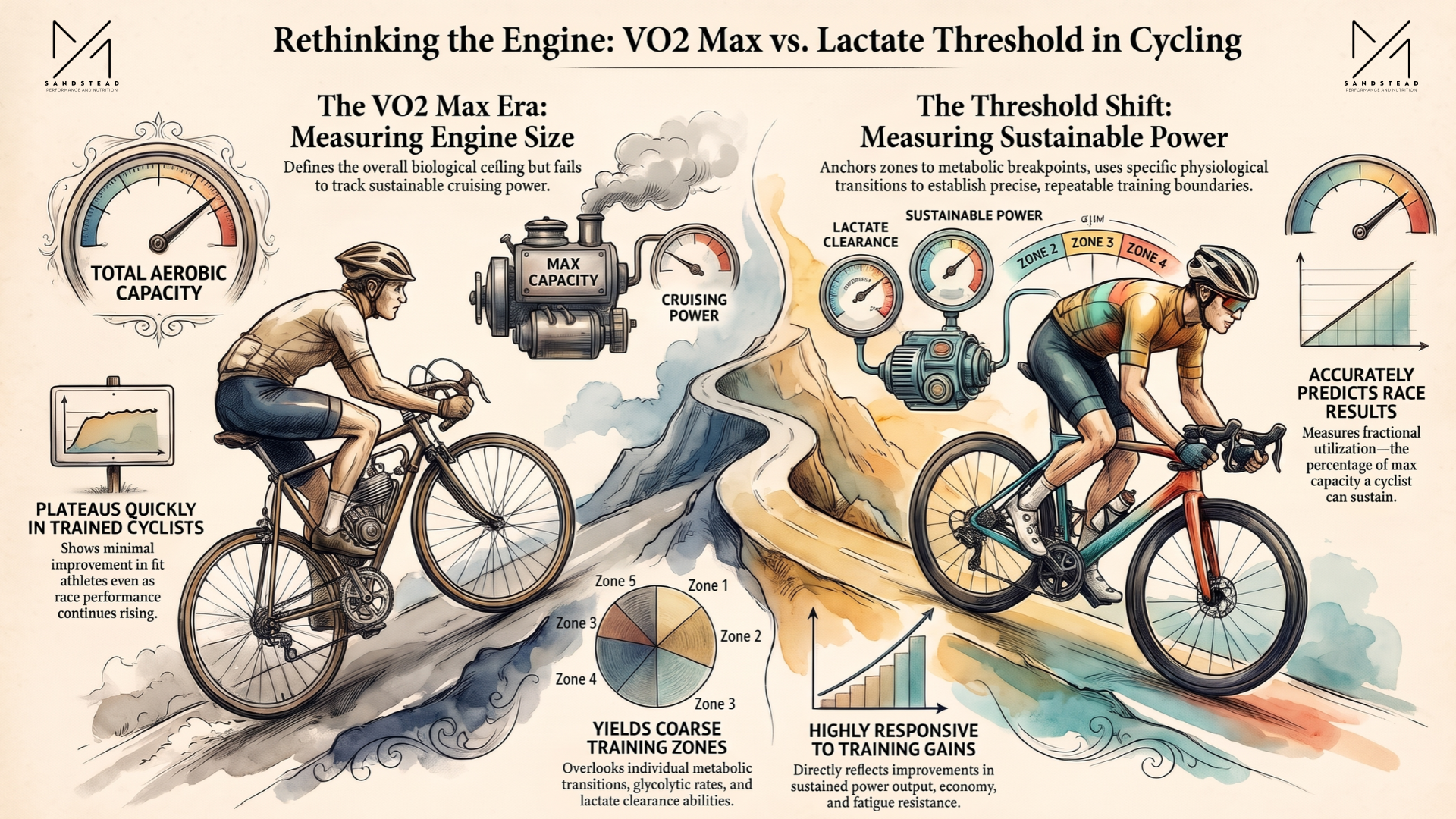
Limited sensitivity in already-fit athletes. Once a cyclist is well-trained, VO2 max often plateaus or improves only modestly, even while race performance continues to rise. Power or speed at the lactate threshold, by contrast, tracks those gains more closely.
Weaker predictor of endurance performance. Among cyclists with similar VO2 max values, the athlete who can sustain a higher percentage of that capacity (fractional utilization) at threshold usually performs better. VO2 max describes the size of the engine; the threshold describes the sustainable cruising power.
Coarse training zones. A fixed percentage of VO2 max does not cleanly map onto the metabolic transitions that matter—when fat oxidation dominates, when lactate remains in steady state, and when fatigue accelerates. Individual differences in glycolytic rate and lactate clearance are invisible to pure VO2-max percentages.
Practical coaching needs. Coaches needed clearer boundaries between intensities that could be repeated for long periods and those that caused rapid fatigue. Lactate breakpoints provided them.
These insights emerged gradually as researchers gained the ability to measure blood lactate easily and relate it to performance.
The Transition Years: 1970s–1980s
The conceptual groundwork began earlier. In 1959 Wildor Hollmann (Cologne) identified a clear breakpoint in ventilatory and blood-lactate responses. In 1964 Karlman Wasserman popularized the term “anaerobic threshold” based on gas-exchange changes.
The decisive practical shift occurred in the 1970s. The Cologne group (Hollmann, Alois Mader, Hermann Heck and colleagues) developed reliable capillary blood lactate testing. Their 1976 paper introduced the widely adopted 4 mmol/L lactate threshold as a practical marker of the aerobic–anaerobic transition. They showed it was more sensitive to training changes than VO2 max and proposed one of the first systematic three-zone models: extensive endurance work below 4 mmol/L, threshold work around 4 mmol/L, and intensive work above it.
In the late 1970s and early 1980s the concepts were refined further (including maximal lactate steady state) and moved into the field. Francesco Conconi’s non-invasive heart-rate deflection test (published around 1980–1982) estimated the anaerobic threshold without blood samples and was applied to cyclists, including preparations for Francesco Moser’s hour-record attempt. Portable heart-rate monitors in the 1980s made threshold-based training usable outside the laboratory. Power meters in the 1990s completed the transition by letting cyclists anchor zones to a threshold power metric (what later became FTP or similar) rather than pure percentages of VO2 max.
What This Means for Endurance Cyclists Today
Modern zone systems used by most endurance cyclists—whether Coggan’s power zones, lactate-threshold heart-rate zones, or polarized models—are anchored to metabolic thresholds (LT1/LT2, MLSS, FTP, or critical power) rather than raw percentages of VO2 max. VO2 max remains valuable as the aerobic ceiling and as one piece of a physiological profile, but day-to-day training intensity and performance prediction center on the thresholds.
The practical payoff is clearer:
Zones that better match sustainable metabolic states
Training that targets the qualities that actually move race performance (sustainable power, fractional utilization, economy)
Greater responsiveness to the training most endurance cyclists perform
The move from VO2-max percentages to lactate and metabolic thresholds was not a sudden revolution. It was a gradual, evidence-driven refinement that took root in the 1970s and became dominant through the 1980s once field tools made it accessible. For endurance cyclists, the result is training zones that more accurately reflect how the body actually produces and sustains power.

template stuff